
This Week’s E-Bike News Headlines
NYC Implements Planned 15 mph Speed Limit for E-Bikes

When we last reported on the NYC mayor’s proposal to implement a 15 mph speed limit, the idea had not yet become law. Starting on Friday, 10/24, the city began enforcing the speed limit, which applies to e-bikes, e-scooters, and commercial EVs with pedal assist.
New York’s mayor, Eric Adams, made a statement about the new law, saying, “”Under our administration, New York City is leading the nation in keeping our streets safe for pedestrians, cyclists, and drivers alike, and I am proud that our work has led to traffic fatalities dropping to some of the lowest levels in New York City history. Our administration has always been one that listens to communities and takes action based on those needs, and, time and again, we have heard New Yorkers from across the five boroughs share their concerns about e-bikes speeding recklessly through our streets. Today, I am thrilled to be delivering for communities across our city by lowering the speed limit for e-bikes to 15 MPH.”
Mayor Adams continued, stating that the goal of the law “isn’t about criminalization; it’s about creating safer, fairer conditions for all New Yorkers.” According to Adams, the city’s focus will start by installing new signage posting the 15 mph limit. During an introductory period meant to educate citizens, first time offenders will receive warnings instead of tickets.
The NYPD will be responsible for enforcing the new limit, but exactly how it will do so remains unclear.
The NYC Vehicle Safety Alliance wants to supplement this change with Precilla’s Law, which would require e-bikes and e-scooters to have license plates if passed by the City Council.
The proposal, which the Alliance says would help identify and catch lawbreakers, hasn’t been voted on yet, but is currently going through the legislative process and is open to public input.
Our Take:
We are strong supporters of safety, and we consider many measures encouraging increased e-bike safety to be a positive for the community. With that in mind, we are largely opposed to NYC’s new speed limit for two reasons.
First, the ability to keep up with traffic while riding an e-bike makes traveling alongside cars safer on congested roads. Cruising at the same speed as vehicular traffic prevents riders from being passed. It also allows them to pass through intersections (notoriously dangerous areas for cyclists) faster, exposing them to less potential harm.
Second, analog bikes are not restricted to the same 15 mph speed. As such, riders who are able could still exceed the speed limit city officials are deeming safe for e-bikes. This comes across as discrimination toward a specific mode of transit that has gained popularity for being easier and more affordable than owning an automobile.
We would be more supportive of New York’s efforts if the city focused on rider and pedestrian education. Many cities in California, other areas with growing concerns over e-bike safety, have implemented training classes to familiarize riders with the safe operation and use of e-bikes.
ALSO Releasing E-Quad Models, Amazon to Buy Thousands For Delivery Fleet
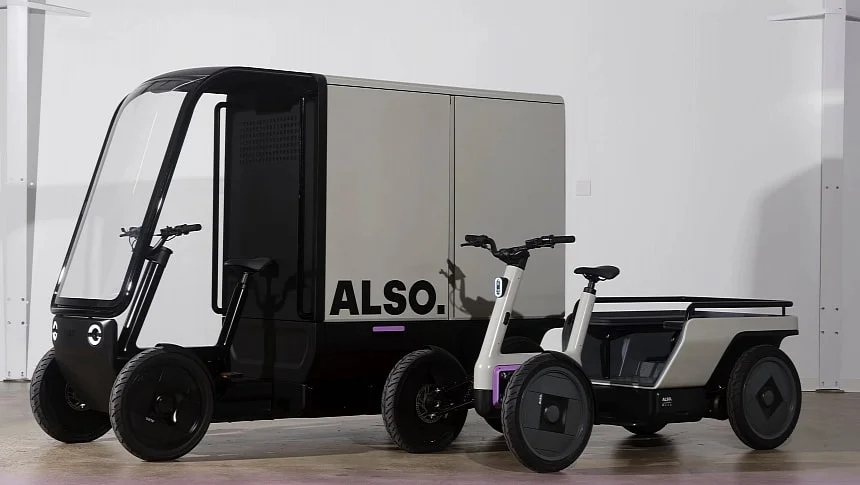
Image Source: Auto Evolution
As we touched on when detailing the TM-B, a new e-bike from Rivian’s micromobility brand ALSO, the company also has plans to release an electric quadricycle. This vehicle, called the TM-Q, will be available in both consumer and commercial variants.
Both models can be used in bike lanes to bypass congested streets and share many of the same design elements as the brand’s e-bike. It is also possible that they will share some components, though details are still relatively scarce.
The consumer version of the TM-Q features bench seats and plenty of cargo space. As stated on ALSO’s website, the commercial vehicle is intended for “transportation, logistics, or delivery fleets,” with a customizable configuration for packages, passengers, and more.
Amazon plans to purchase and use thousands of the commercial models for delivery across dozens of locations.
The director of Amazon’s global fleet, Emily Barber, said, “Amazon already operates more than 70 micromobility hubs in cities across the U.S. and Europe. Micromobility solutions like pedal-assist e-cargo quads allow us to quickly deliver to customers in dense, urban cities, while helping reduce traffic and noise. Similar to our Rivian EDV partnership, working with ALSO provides an opportunity to continue to innovate in this space, building on our delivery logistics experience, paired with their advanced technology, safety, and performance features.”
Our Take:
We definitely see the potential for these vehicles to help move and deliver packages faster and reduce emissions. From that perspective, Amazon’s move makes a lot of sense. If the vehicles take up too much space in bike lanes and end up forcing cyclists into traffic to get around them, it may be somewhat counterproductive.
Galfer & MAHLE Collaborate on a Disc Shark eMTB Rotor Prototype

Image Source: Cycling Electric
Historically, speed sensors typically require two components: a magnet mounted on the wheel hub or a spoke and a separate sensor unit on the bike’s frame or fork. These setups can get dirty, damaged, or become misaligned with sustained vibrations or impacts.
The new prototype rotor disc, which leaves the Disc Shark’s design largely unchanged, includes a slot for the M40’s speed sensor. The design allows the sensor to be integrated directly into the brake system instead of being added to it. It also keeps the sensor protected, aligned, and clean, while retaining the standard rotor’s performance.
While currently in the development phase, the rotor design is set to hit the market in 2026. Pricing information is not yet available.
Our Take:
The bottom line is that this design seems extremely smart. If a relatively fragile piece of technology essential to an eMTB’s function can be protected and integrated into an existing (and more durable) system, that seems like a great idea to us.
If the design works as well as expected, we wouldn’t be surprised to see similar ideas adopted by other manufacturers. This kind of innovation has the potential to shape the future of the industry. It could also reduce both the need for replacement parts and the frustration of e-bike owners who often need to clean or realign sensor components.
